I must put plasters on the shopping list.
DH was making anti-bunny cages for the plants yesterday and had a slight argument with a hacksaw. Ouch. This is not unusual when he is doing ‘things’ in the garden – sometimes it’s his head, sometimes his fingers – luckily for him today it was only his finger.
This is why a flat tyre might prove fatal one day if we needed to get to A&E.
I continued in the trellis border….. all 40ft of it. It is beginning to take shape, well some kind of shape – not exactly the shape I had intended but I can titivate it later; flowing curves are not easy to cut so they look good from all directions…..
…. but for now the hard work is done, the lawn edged, the bed weeded and the stones removed other than the ones that are there for decoration or bunny protection.
This is the end of the border before….
and after……
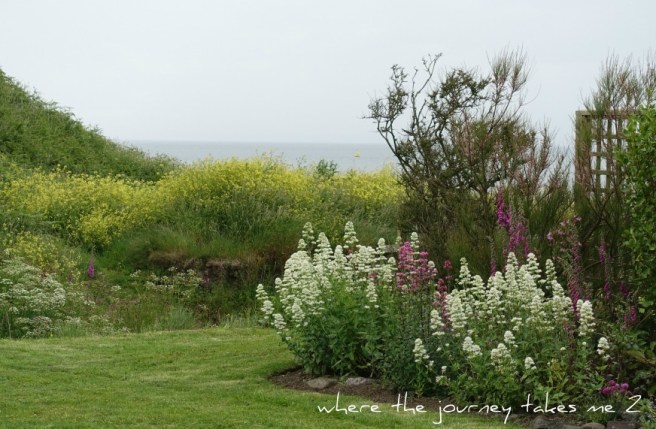
When I get the rest of the planting in and there is less bare earth and more colour it will start to look better. As this is the seaside garden I am planting a mix of seaside plants – Valerian (a good spreader and so far anti-rabbit), lavender, Santolina, kniphofia, Erigeron and thrift.
No doubt by our next visit it will once again be covered in weeds and maybe bunnies.
Rag, Tag and Bobtail have now been joined by bibbity and bobbity, hippity and hoppity and what seems like many distant cousins.
But the sly old fox is very close on their tails – hiding in the gorse – just waiting his chance.
I am still keeping a few bunny cages in place just in case…..
…and a few stones to prevent nibblers from damaging the roots whilst the new plants ‘settle in’ and grow stronger.
At last I have uploaded the photos of our little venture last Thursday. After climbing the ‘mound’ we set off travelling north on the road to New Luce that runs on the eastern side of the Stair estates at Castle Kennedy just outside Stranraer. Suddenly, as if from nowhere, a Hen Harrier flew overhead (Lord Stair had mentioned to DH sometime ago that they are nesting on his estate at Castle Kennedy), a beautiful bird and quite a size with a very large wingspan. It came extremely close to us and swooped past gliding gracefully into the woods. Apparently, there are not many in the UK so we are lucky to see one. Sadly it was one picture that I didn’t manage to take.
New Luce is a tiny conservation village part of the Glenluce parish. It is on the road to nowhere and developed as a village through the necessity of having a meeting place for all the local outlying farms of such a large parish. It is like an oasis in the dessert only here it is a lush oasis in the middle of moorland. The locals affectionately call it Nineveh. There are 62 homes and about 90 residents of all ages.  It is positioned where two rivers meet – the Main Waters of Luce and the Cross Waters of Luce. Like the river the two main streets of the village form a T shape each of which has a bridge over one of the rivers.
Take any of the four roads to New Luce and you will not pass through any other village or hamlet on the way, save Glenwhilly, which I believe is nothing more than a couple of houses clustered at the old station on the way north to Barhill; strangely it boasts Scotland’s most remote signal box though goodness knows where the passengers would have come from in such an uninhabited place.  Like New Luce , the station at Glenwhilly closed in 1965.
Glenluce, a small rural village to the South of New Luce has a village shop and is the closest place 5 miles away, and where the younger children now attend school, Stranraer is 9 miles to the South west and Barrhill 13 miles to the North so it feels more isolated than remote; surrounded on all sides by open moorland (that has not yet fallen to any great swathe of forestry planting) and where sections of the winding road are single track with passing places and cattle grids. As you descend down from the moors towards the village the scenery changes into a more gentle landscape of farmland with farmsteads dotted here and there….
– complete with grazing sheep…. lots of them
and on the road too….. and in no hurry.
We entered at the lower end of Station Street.
Just to the left of the picture stands this old iron bath tub filled with an array of flowers. Just one of the many repurposed artefacts around this village.
At one time this old tub was to be found in one of three Inns as this notice tells me. That is a lot of drinking establishments for such a small place. Interestingly in the 1846 census there were not only 3 Inns but several village shops serving 278 villagers and a school attended by 50 children.
It is a haven for the red squirrel;Â sadly we saw none on our visit but I just love the way the locals in this area make the road signs their own and have added a cheeky little apple sticker – often the cow signs have been adapted to resemble the belted galloways with the white band.
And just look at this wonderful play park for the handful of children who live here. Libbie would have loved to play in here for the afternoon.
Over the Main Water bridge now and I just had to take a picture of this house with the sun pod in the garden – I have only ever seen them displayed in John Lewis before and wondered who bought them!
They had a collection of rare breed sheep wandering about- the one at the back resembling a big teddy bear was so cute.
Opposite is the little village shop and Post Office offering free herbs in the window boxes, beside it is a red telephone box (mobile signal is poor) and a post box – all a good sign of a thriving village.
With limited stock and limited opening hours and a bus service only on 3 days of the week and no train link you do not want to run short of anything living out here.
At the top of Station Street is the junction with Main Street and what appears to be a little public garden, where a cottage once stood, no doubt lovingly tended by the local villagers.
It must be one of the best kept villages I have seen in ages and I love the way they reuse, repurpose and recycle so many discarded objects, turning them into planters and sculptures as you will see on our little walk around.
At the back of the garden was a flight of gravel steps leading up to this monument – we couldn’t quite read the inscription on the stone but given its position here it must be quite important to the village.
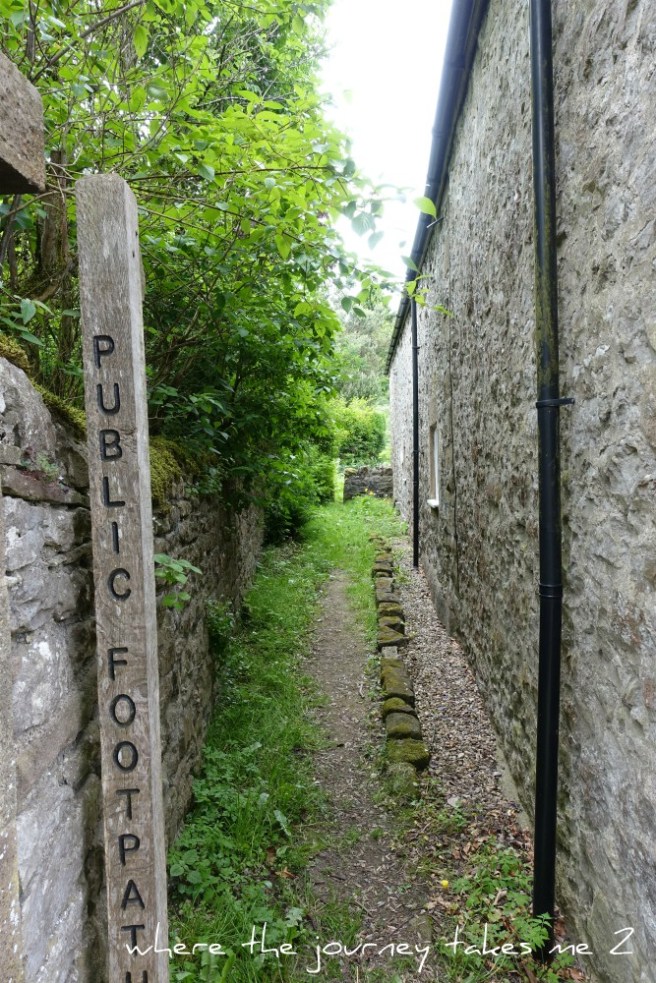
The gravelled path continued along what seemed to be a little lane running high above Main Street at the back of the row of cottages.Â
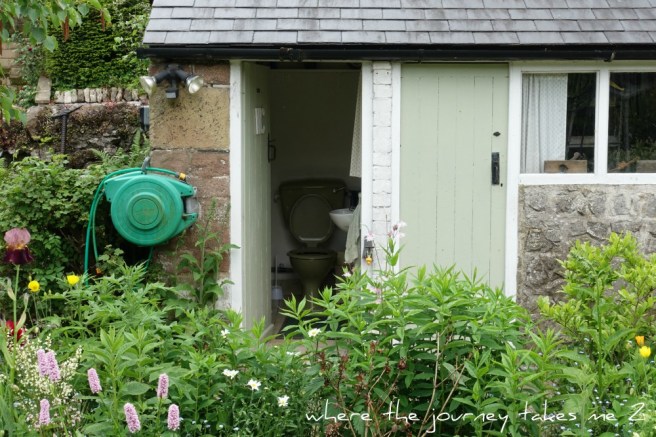
Here we found some very curious allotment style gardens with sheds…..I have never seen so many sheds in such a tiny village….everyone had a shed, or two or three!
The Ferrets Nest certainly appeared to be more of a weekend chalet than a shed. And one or two had a caravan – possibly in use!
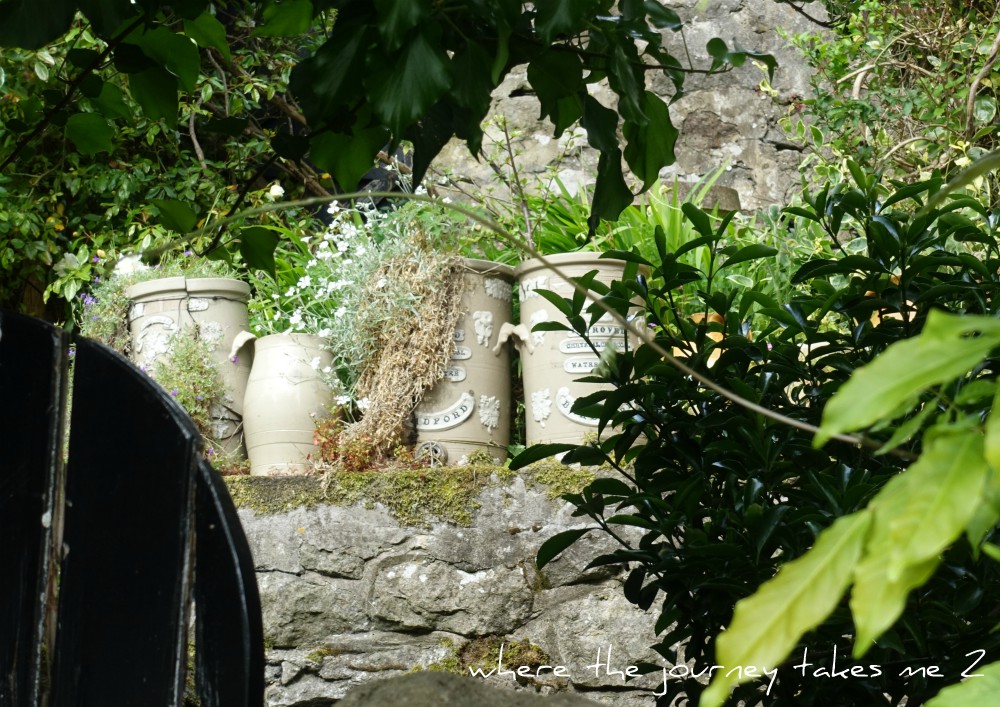
And whichever wall you looked over everyone had a display of household artefacts and recycled objects …..
or even an old ruin in their back gardens.
Eventually the little lane came out onto the main street again.
Some of the cottages had quaint window displays inside and out….


and fancy wall plaques…
sadly not all were delightful – this window is displaying a notice announcing a closure –
It appears that the last of the Inns, the Kenmuir Arms Hotel, is also now ‘closed until further notice’ – the owners having closed up in the winter of 2018, gone abroad and as yet not returned. Though noticing a skip outside the back with mattresses dumped in it I am thinking perhaps they are not reopening. It was a popular Hotel – especially with walkers…
and campers who could pitch their tents down at the bottom of the Hotel garden by the water ….with the midges.
Going further along Main Street and over the second of the bridges (Main Bridge) I came across this cute little cottage with a recent extension… 
It is possible it might have been a Toll house.
This garden outside this chalet caught my eye – where else in the world would you come across a scene like this on the road side where there is an open invitation to passers by to play with the little toy cars…….and no one steals them!
There were so many unusual things to see in this village I will take a break here and continue in part two a few steps away at the church and village memorial hall.
Apologies if there are spelling mistakes, it is late, I am tired and WordPress spellcheck has disappeared off the editing toolbar.
Back soon x

The stream border is on the northern side of the cottage. Edged with pine trees, rosa rugosa and the Fatsia which needs pruning, it has become a bit leggy but keeps the border cool and shady and protected from any strong inland winds. The buds on the rosa rugosa and hydrangea in the border are only just starting to unfold as they too were quite leggy and I cut them back quite hard this year.
Meanwhile in the trellis border on the seaside of the cottage the plants I put in last year…
Around the garden, especially in the lower wood and woodland walk, things are stirring and beginning to flower.
Solomon’s Seal
Dicentras and Tiarella
and apple blossom.
I woke up this morning so late, it was a quarter to ten when I finally got up – I think I had gardened myself into a standstill yesterday so we decided a day doing very little was in order.
The Mound of Droughduil was identified only a few years ago by archaeologists from Manchester University as Neolithic dating back to 2500BC and not Medieval as originally thought. In stone age times it was a ceremonial centre and meeting place for the local community. We went to take a closer look today as it is magnificently covered in Bluebells.Â
We climbed up to the top –it stands some 30 feet high and is quite flat on the top – a lovely place to picnic maybe – just a touch draughty; the summit being reached by a tiny trail path through the grass and bluebells. Strange to think how many feet through the ages have trodden on this very turf. Although not quite the dizzy heights of the Eifel Tower the view from the top is still worth the climb.
Going down seemed much steeper than going up.
Afterwards we took the road up to New Luce – but that is a story for tomorrow. For now it is my bedtime, DH is already tucked up in bed – I can hear the gentle wafts of snoring coming from the bedroom – no doubt I will be back in the borders tomorrow. x
We drove down the steep winding road from Holme Moss to meet the notorious Snake Pass and then along the valley bottom and over to Glossop, a small old mill town in the High Peak enjoying a bit of a revival, where we stopped and rang an old college friend of mine who lives close by on the off-chance they might be at home. She and her new partner came to meet us and we enjoyed a lovely relaxing afternoon with them in a local cafe chatting and catching up.
Venturing up one or two of the side streets we came across this fine old building – the Glossop Gas Works which is now home to a few new business enterprises. Before Gas became available the mills like everywhere else would have been lit by candlelight through necessity to work 24 hours a day. This was expensive and so the textile mills were one of the first places that were used to develop this new technology and demonstrate it to a very sceptical public.
We crossed the road and began our walk back, once again exploring a few of the side streets as something caught our eye, and discovered this unusual church building – The Central Methodist Church.
I tried to get a photo of the light flooding the inside of the chapel through the windows around the back. Perhaps on another visit we might be able to go inside.
On the corner of High Street West and George Street we came across the Oakwood. This site has a long and chequered history since 1844 when originally it was an inn owned by George Pye and remained in his family till 1875 when it was sold and demolished to make way for a very grand hotel complete with balcony and flagpoles at a cost of £6,000. In fact there are many balconied buildings around Glossop.
During its time the spire has been removed and in 1901 it was bought by Robinson’s Brewery and had a major renovation in 1991. Today it is still with the brewery and is a popular place to eat and drink.
It struck me that the streets here are unusually wide compared with a lot of mill towns – hence the name dark satanic mills because the mills were tall and the streets narrow and claustrophobic. Here it felt much lighter.
The mills around Glossop mainly produced cotton, as more mills were built more people had to be ‘imported’ in to the area and the town grew in size – a town hall with adjacent market hall and shopping arcade, now one of the popular attractions here, was built in 1938 by 12th Duke of Norfolk at a cost of £8,500 – not quite as glamorous as the shopping arcade in the centre of Leeds but none the less it has some handsome architectural merit and is currently undergoing extensive renovations and covered in scaffolding and sheeting so I wasn’t able to take a picture of the front of this grand domed building but here is a peek inside.

Opposite the Market Hall is the town square – so very well kept with borders running along each side that are a riot of colour and a credit to the Council.
In the centre of the square is a war memorial with a statue of an angel gracefully holding a laurel wreath – it is quite beautiful and a fitting tribute to the many men of the town who gave their lives in the war.
There were some very wealthy mill owners in the area which generated rather a lot of rivalry between them. This in turn benefitted the local people as each of the mill owners built public buildings such as the public baths, parks and libraries for their workforces. Mrs Wood, wife of John Wood donated four drinking fountains to the town of which I believe this could be one of them. 
Edward Partington owned one of the paper mills and as he was a Liberal laid the foundation stone of the Liberal club. He also built the library and a convalescent home.
The former Liberal club I think is one of the finest buildings on the square with yet another small balcony – it was turned into a small theatre in 1957 and became a new home for the Partington Players.
…..watched over by a statue of Hamlet…
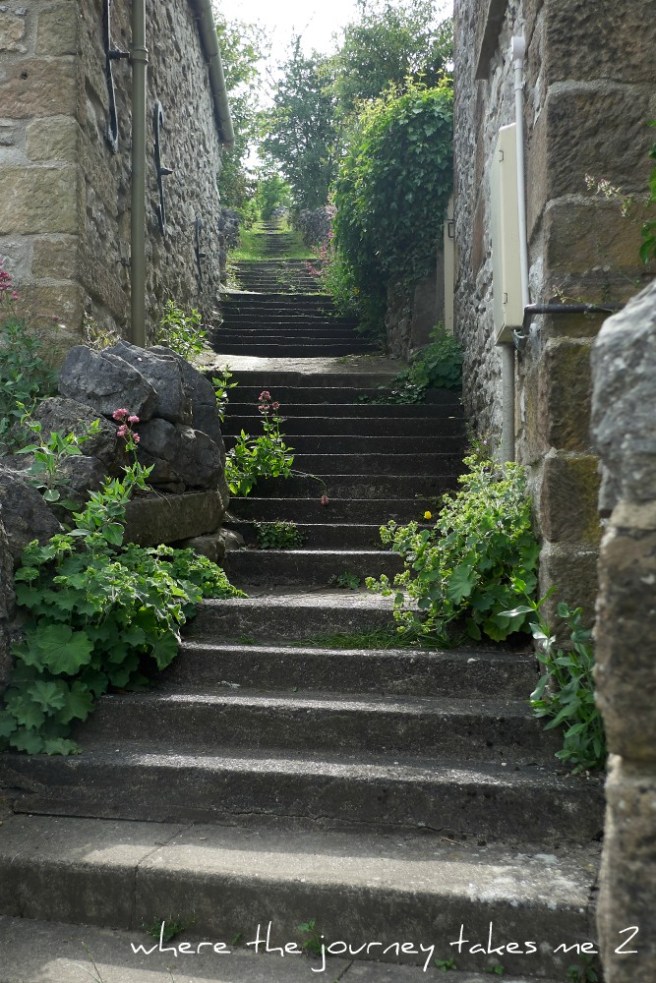
Just off the back of the square past the Theatre is a rather grand flight of steps up to the station forecourt.Â
The mystery little cottage to the right of the photo above built into the slope has a cute little garden, now overgrown but with signs of herbs and vegetables being grown up to very recently. To one side it has a wooden first floor extension which from the other side resembles some kind of ticket office – but as yet I have no clues as to what it might have been use for.
And this is where we finished our little stroll – I hope you enjoyed your visit to this lovely little mill town – sadly many of the mills have been demolished now but a few survive with a new lease of life as shopping centres and businesses. It was a hard life in a mill town, the mill owners were quite entrepreneurial people in their time as the industrial revolution took hold and they became very prosperous mainly due to the hard work of the people who toiled long hours day in and day out in these noisy, dust ridden buildings.